Monday, 5 December 2016

Tackling the Terrors


Foreigners wait for help. — AFP

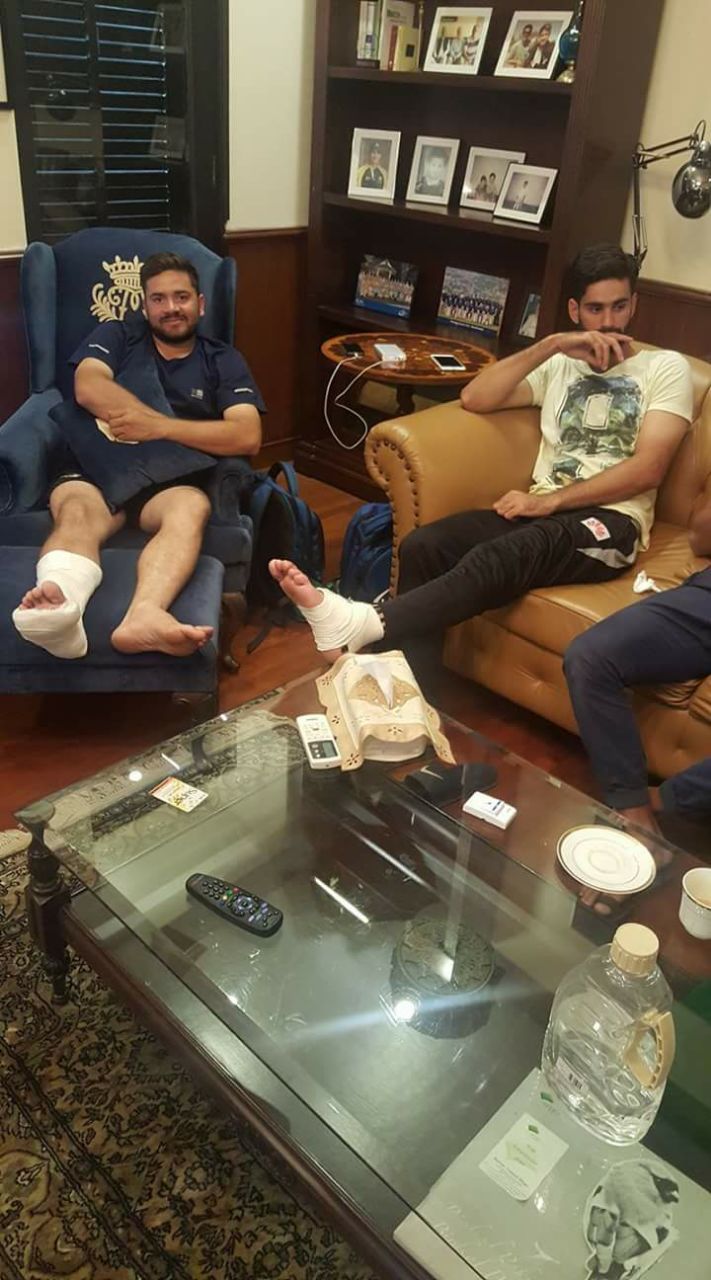
The deadly fire that erupted in a hotel in Karachi on December 5, 2016 that killed 11 people and injured over 70,  also hurt some Pakistani cricketers who were staying at the hotel. According to reports cricketers from UBL's first-class team that included some international Pakistan cricketers like Sohaib Maqsood, Hammad Azam and Umar Amin were in Karachi to play Quaid-e-Azam Trophy's super 8 round match vs HBL. When the fire set ablaze they with their team were staying in hotel and the tragedy resulting in injuries to UBL' cricketers Yasim Murtaza and Karamat Ali. Although shaken themselves, but other cricketers notably Sohaib Maqsood along with his teammates, helped in rescuing guests trapped inside the ablaze building, Besides, helping in evacuation a few families and small children they also helped in rescuing and evacuating Chinese officials affected by the fire.


This brave and humanitarian act of  cricketers to save life of others putting their own lives in danger, shows a positive characteristic of Pakistan' socio-civic culture, which is struggling to  survive from uproar and instability fueled by militancy and bad governance. That also indicates that attitude of national society is changing and it is heading towards positivity. Since the last two decades people living here were badly affected by horrors of terrorism which resulted in poor law and order and bad governance. Human lives were in a state of survival, therefore foriegners were afraid of touring Pakistan. However with these rescuing attempt of cricketers, it seems now people living in Pakistan including sportsmen have now understood that "God don't help those who don't help themselves."

It also reminds me a well known sporting family of Lyari, who lost their lives while resisting young and under-trainee pugilists of their boxing club to involve in criminal activities. The deceased are named Muhammad Ismail, his elder brother Javed and Taj Muhammad, maternal uncle Taj Muhammad, and their two cousins Shoaib and Faisal. All of them were national-level boxers and running a training academy in Singhu Lane. That boxing coaching centre was in operation for youngsters of Lyari for several years. But when gangsters tried to recruit members from their boxing club, the family not only resisted their attempt, but also started a campaign to stop young men from joining the gangs.

The gangsters working for notorious warring leader Uzair Baloch, therefore, started harassing the family and forced them to flee Lyari. The members of the family kept in wandering from one neighbourhood to another as gangsters had torched their houses in Singhu Lane. After few weeks of their relocation, a group of 12 gangsters tracked them down, kidnapped all of them and brutally killed them on March 9, 2014.

Two and half year later on November 19, 2016, the law Rangers in Karachi in a raid killed three hitmen including Mullah Arif who was supposed to be the main perperator of the gangsters group that killed the members of boxing family. The warlord of the gang Uzair Baloch has already caught earlier this year and is now in custody of law enforcement agencies.


However the residents of Lyari claim that the killing of Mullah Arif is an important success in the ongoing crackdown on Lyari’s criminal syndicates and will further weaken the notorious warring gang .


By M. Wasim

mwasim.370@gmail.com

Wednesday, 19 October 2016

How about a team of Pakistani expats in PSL ?


Cricketers of Pakistani-origin in the contemporary cricket world can be widely traced. Three out of sixteen members of English Test cricket squad touring Bangladesh these days are of Pakistani-descent. They are batting all-rounder Moin Ali, leg spinner Adil Rasheed and left arm spin bowler Zafar Ansari. Earlier before them, many English Test cricketers of Pakistani origin like -- most recently and notably -- fast bowler Sajid Mahmood and batsman Owais Shah had also represented England national cricket team before their unannounced retirement from Test cricket. The families of Moin Ali and Adil Rasheed belongs to Mirpur, Azad Kashmir, immigrated and settled in England decades ago, while Zafar Ansari is the son of Khizar Hayat Ansari who is a famed scholar migrated from Lahore and whose elder son Akber Ansari is also a first class cricketer in England.

 These are not the only international cricketers of Pakistani-origin in the contemporary cricket world, in fact the list goes on a bit further. As in the Australian national team there are Test opener Usman Khwaja who born in Islamabad and leg spinner Fawad Ahmed who left his native land because of security threats from radical militants in 2010 and inducted in Australia national cricket team in 2013.

Imran Tahir needs no introduction. The South African leg spinner born in Lahore and even represented Pakistan under-19 and Pakistan A teams. However, when he saw that he could not progress further because of bundles of quality spinners already present in Pakistan, he decided to ply his trade in South Africa. After years of playing county and domestic cricket in South Africa he represented the Proteas in 2011. Similarly Zimbabwe Test batsman Sikandar Raza born in Sialkot and emigrated to Zimbabwe in 2001 to make his debut as Zimbabwe Test cricketer in 2013.  

Usman Khwaja, Fawad Ahmed, Imran Tahir, Moin Ali, Adil Rasheed, Zafar Ansari, Sikander Raza all belonged to the ICC full member cricket playing nations, while there are hundreds of more cricket internationals who are of Pakistani origin but playing for other ICC associate and affiliate member countries like Canada, China, USA, UAE and etc, making Pakistan the top exporter of cricketers worldwide.

The fame of Pakistani-descent international cricketers comes at times when international cricket activities are extinct in Pakistan. Because of fragile law and order situation not only international sportsmen and teams are reluctant to travel Pakistan, the country (with the exception of limited overs series against Zimbabwe in 2013), has not held any international match since the attack on Sri Lankan cricket team in 2009. So Pakistan is dependent on Gulf emirates as home to hold their bilateral cricket series and other cricketing events of international repute for the survival of the game and their cricket fraternity. 

Most importantly, Pakistan has been forced to hold their first ever professional and most lucrative Twenty-20 event the Pakistan Super League (PSL) away from their land, because foreign cricketers as usually fear to travel and play in Pakistan citing security concerns. Despite that the first edition of the Twenty-20 league was marked with huge success contemplating the PCB to expend the event in terms of participation. According to plans for the first two annual editions the league would be limited to five teams representing four provinces and federal capital. But after that the number of teams will be increased bringing Azad Kashmir or the fifth province Gilgit Baltistan in their format. However, while doing so the Pakistan cricket authorities haven't considered yet the important chapter of overseas nationals and Pakistani expatriates. At a time when the country is facing threat of international isolation, it needs passionate unity and collective participation of people from all walk of life including the "Little Pakistan."


The need of any professional cricket league in Pakistan was being long felt. However, the problems the country was to face (and is still facing) that it could not experiment any new cricket event at home because foreign cricketers were not willing to play in Pakistan for security reasons. More serious, these days mega and popular sports event are at high risk even in safe and developed countries because they are supposed to be attractive targets of terrorist providing them platform to flex their muscles to attain world-wide exposure. And, Pakistan' delicate law and order situation is an open secret. So,  Pakistan Cricket Board had to launch the event abroad in depleting conditions. Because of limited resources and revenue it was difficult to attract and convince franchise owners to invest in a league which was yet to launch or in experimental phase. So the PCB started it with five franchise teams namely Islamabad United, Karachi Kinds, Lahore Qalender, Peshawar Zalmi and Quetta Gladiator, and brought them in agreement for two years. But now they are looking to expend the size of the league in terms of number of teams. A Franchise of Kashmir is almost certain (as tweeted by the PSL head Najam Sethi) However, there is still a need that Pakistanis from all walk of life, living at home or abroad, must be represented at this global forum, that's why Pakistani expats now deserve this partaking.   

The concept looks flimsy, and definitely it is only one of its kind but not out of context keeping in mind the current scenario and problems faced by Pakistan. It is the only cricket nation who hold their home matches outside their homeland depriving local spectatorship and losing a sizable gate money in their exchequer. Their cricketers are officially barred to play in the Indian Premier League and the game' governing body the ICC is toothless on that matter. If Pakistan can be granted to hold their international cricket matches and the professional Twenty-20 league abroad for security reasons why can't, in these circumstances, a franchise of Pakistani diaspora be fielded in PSL, ideally representing international cricketers of Pakistani-decent or expat Pakistani cricketers blended with required quota of foreign internationals in a Playing-XI. That will enhance the sporting image of Pakistan as a global partner, provide more attraction to the event , force international community to reconsider about Pakistan sporting isolation and retain the confidence of Pakistani expatriates living around the world.
   
These Overseas Pakistanis who are now vital organ of national economy deserve credible importance and active representation in the country' socio cultural arrangements. Around eight million overseas Pakistanis  are remitting more than $1.5 billion monthly, making a significant contribution in national exchange reserves. The State Bank of Pakistan expects remittances to cross $20 billion this financial year, the highest ever in their history. Keeping in mind the importance of these expatriates, the state of Pakistan has not only allowed them to retain dual or multiple nationality but also is going to facilitate them in use of their political enfranchisement for the next general election through electronic voting. Therefore a team based on overseas Pakistanis origin in the PSL will further provide them greater sense of national ownership and a genuine representation at the highest international sports forum.

For the 2017 PSL draft a number of international cricketers, both nationals and foreigners, have been inducted in the list recently and their selection will going to be finalised in the next week. Thereafter the dates of the PSL-2017 will be finally scheduled in the Governing Council' meeting. Where, it would be a wise time to introduce the concept of an additional team of Overseas Pakistanis for the third edition of PSL, held in 2018.


The move of inducting overseas Pakistanis team can win back the confidence of cricket talent which is leaving the country because of limited choices and security threats at home-- as happened in the case of Imran Tahir and Fawad Ahmed respectively.  


By M. Wasim

mwasim.370@gmail.com
(Written for Tribune October 14, 2016)

Wednesday, 12 October 2016

Culprits of 2009 Sri Lankan cricket team attack, met their fate.

Image result

Hopes of international cricket returns to Pakistan have begun breathing again with the death of the organiser of the 2009 attack on the Sri Lankan cricket team. Qari Ajmal a fugitive leader of the banned Lashker e Jhangwi was killed in a joint operation by the NATO and Afghan troops in Afghanistan province of Patika on October 9, 2016. With his death almost all the culprits involved in the attack have finally met to their ends.

That attack on the Sri Lankan cricket team is globally considered as one of the most impactful act of sports terrorism, when a bus carrying cricketers and officials was attacked with AK-47 rifles and grenades near Gaddafi Stadium in Lahore on March 3, 2009. Seven players and an assistant coach were wounded while two passengers and six Pakistani security personnel died defending them during the attack. Since then international teams and sportsmen refused to play in Pakistan and similar kind of terror incidents were started increasing on local sports fraternity. Sports were declining in the country and in terms of quality and world rankings Pakistan were legging behind in various sports disciplines  The country has become a "Sporting Pariah" and is forced to hold home cricket series and other sports events in the UAE.

Image result
Pakistan security officials during their investigation arrested more two dozen suspects in connection with the attacks belonged to Jaish e Mohammed and Lashkar e Jhangwi, outlawed militant groups with close links to Al Qaeda. According to  their reveals the attack was believed to have been carried out by Lashkar e Jhangwi, led and masterminded by Mohammed Aqeel alias Dr. Usman.  

Under the operations of the Zerb e Azb and National Action Plan in 2014, Pakistan witnessed a shift of internal security command from provincial police to military establishment. These para military forces have launched serious and robust military operations against all kind of religious extremists and ethnic militants across the country. Anti-terrorism and Military courts established in the provinces and moratorium on death sentence was  lifted from laws.

Image result

On June 22, 2016, an anti-terrorism court in Lahore indicted six people for involvement in the 2009 attack on Sri Lanka’s cricket team in an in-camera proceeding held at Lahore Central Jail. These suspects namely Adnan Arshad, Ibrahim Khalil, Obaidullah, Javed Anwar, Abdul Wahab, and Zubair pleaded not guilty. Earlier the court had already declared two suspects, Mohsin Rasheed and Abdul Rehman, as proclaimed offenders.

However, on August 2016 in Lahore in a police encounter four terrorists were killed  among them three Zubair alias Naik Muhammad, Abdul Wahab and Adnan Arshad were allegedly involved in the attack on the Sri Lankan cricket team in 2009. The rest of the convicted are behind bars. Their leader Mohammed Aqeel, who escaped a police raid at his home on 9 March 2009,  was later captured in October 2009 while holding hostages and trying to blow himself up. He was sentenced to death by a military court in 2011 and  in the evening of December 19, 2014 Aqeel was hanged till death with many other militants.


An Islamist militant accused in dozens of killings and a 2009 attack on Sri Lanka's cricket team was freed on bail on Thursday after 14 years in custody because the Supreme Court decided there was not enough evidence to keep holding him, his lawyer said.
 The head of the Lashkar e Jhangwi Malik Ishaq and the main alleged instigator of the attack, had already been killed  in July 2015 during a crossfire between militants and personnel of Counter-Terrorism Department. And, now on October 9, 2016, with the death of Qari Ajmal the alleged organiser of the attack, almost all the culprits involved in the terror incident have been vanished.

The impacts of the Zarb e Azb and National Action Plan are remarkably positive, as they have definitely succeeded in restoring some peace and stability in Pakistan. The law and order situation has improved and religious militancy has reduced in the country. And, these operations are the reasons that culprits involved in the Sri Lankan cricket team attack, and depriving Pakistani spectators to watch international sports and cricket at home, are no more in the world.

Image result


Now people can hope that international cricket activities and other sports events can be staged at home soil without any untoward incident. Yet, it is still up to Pakistan sports authorities and let's see when they start to prioritise sports.        


By M. Wasim

mwasim.370@gmail.com

Sunday, 9 October 2016

Barmy Army avoids come to support amid security fears


Reg Dickason, the England Cricket Board's security chief who endorsed the tour after a field trip to Bangladesh, expressed his satisfaction with the safety measures after his team arriving in the South Asian country for 3-week long Test and limited over Series . Extremely tight security measures are being followed and war-like rehearals (in case of emergency) are carried out by Bangladesh sports security because Australia had already pulled out of a planned tour a year ago after their cricket board cited a "risk of terrorism", so this time the Bangladesh Cricket Board is desperate to avoid the fate of Pakistan who -- apart from a lone series against Zimbabwe -- have not hosted any international cricket since gunmen attacked Sri Lanka's team bus during a 2009 Test in Lahore.
However, when Dickason told reporters. "The security overall ... in Bangladesh is outstanding" and "It gives a lot of confidence," it would really impress the Barmy Army, who declined to travel with the English cricket team owing to prevailng security concerns. A few excrepts of their detailed statement on their website reads out as;
"Behind the scenes we have been liaising with the ECB and the Bangladesh Cricket Board (BCB) and have now received advice from the latter. We have been supplied with a list of hotels in Dhaka and Chittagong that will receive protection from the Bangladesh Police and been told that England supporters will be afforded their own segregated area within the stadium.
"However on the issue of escorts to and from stadiums (where due to local traffic conditions supporters will be most vulnerable to attack), we have been supplied with the contact details of a private security company, the implication being that any extra security will have be at supporter's own expense. Whilst we are grateful that the BCB are taking an interest, we feel these measures do not yet go far enough to persuade us to go against FCO advice.
"It is a matter of great regret that we feel unable to endorse travel to Bangladesh. Those of us lucky enough to have visited this country on previous tours have lasting and fond memories of a warm welcome, friendly locals and wonderful food. Perhaps the greatest pleasure being able to mix freely with the general population, particularly in and around the stadiums. We were also able to wander and explore the teeming cities of Dhaka  and Chittagong without fear. FCO advice specifically warns against such activities."

Bangladeshi commandoes participate in a mock drill at the Sher-e-Bangla stadium in Mirpur ahead of the 1st ODI. AFP

The concerns over security for England's tour of Bangladesh began after Dhaka, the nation's capital, suffered a terrorist attack in July that left many dead, casting doubt over whether Bangladesh's security forces could guarantee the England team's safety. Besides the Barmy Army, the incident also compelled the English team ODI captain Eoin Morgan and opening batsmen Alex Hales to opt out of the Bangladesh tour.


 However, the way Bangladesh security personnel have demostrated their security capability ahead of Test series, it definatly do away the English cricketers concerns. Their hotels in which English team stays has been given several layers of extra security and  on their way to Fatullah stadium, they are accorded with VVIP security which doesn't allow the fleet of vehicles to stop at any crossing or roundabout in the busy Bangladesh capital. The forces involved in maintaining security in this series include the Dhaka Metropolitan Police, SWAT, Special Branch, Detective Branch, Rapid Action Battalion and the Bomb Disposal Unit.

By M. Wasim

mwasim.370@gmail.com

Sunday, 18 September 2016

Drones tech; a potential threat to sports


Play was briefly stopped at Valley Parade due to a drone flying above

Security experts widely believe that unmanned aerial systems pose a legitimate threat to sporting events. That is the reason  when a drone was spotted hovering in the air above the pitch in Bradford City's home match against Sky Bet League One rivals Bristol Rovers, the referee Andy Haines brought the game to a halt in the 65th minute with the scoreline goalless and subsequently decided to take both sets of players off due to safety concerns.  Play, however, resumed three minutes after the incident, with Haines satisfied that the safety of the players and supporters were not at risk, but it left concerns for safety and security of games.

Drones and aerial cameras are increasingly popular technology in almost all sports and game events, being used for media coverage, live telecast and impactful cinematography, but there is no denying they could be be a potential threat.These devices are not only becoming cheaper and easier to own, but technology has advanced to such a point that virtually anyone — hobbyist or terrorist — can fly one.

In a similar incident a drone flew over the pitch during the Serbia vs. Albania UEFA 2016 qualifier bearing an offensive flag, which resulted in the teams and spectators brawling with each other and the match being stopped.

The potential impact drone attacks can have on sporting event safety has rapidly progressed. While security professionals are focusing on drones as they relate to security and privacy concerns, drones' impact on the future of event security remains unclear.

By M. Wasim

mwasim.370@gmail.com

Sunday, 11 September 2016

Sports Security in context of 9/11.

Image result

 The USA is perhaps the most vigilant country to counter sports terrorism. The Home department in America has developed special units, squads and carried out case studies to do away with the threats and insecurity that plague game events.  Their authorities don’t waste time to collaborate with other nations in sharing information in case of any untoward incident related either to sports or not scoured anywhere. Travel warnings to their citizens and sportsmen on foreign tours and their surveillance abroad are considerate measures of the USA to put a check on terror threats during games. And, the super power doesn’t hesitate to even postponed or cancel sports event abruptly if it feels any security threat is present. The rest of the world is not ready to respond like, the United States.

Despite these measures, it the US is the most self-perceived insecure country in the world when it comes to sports terrorism. This is because in the US, sports has a 52-week sport activities calendar and is the richest in the world with major cash-rich leagues like Super Bowl, NFL and many more, that provide both fun and finances to locals. An attack on these sport events would mean less attendance, lesser recreation and even lesser business. Second the Americans are the most sought-after people in the world to be targeted for political reasons, as an attack on them leave greater impacts and global exposure. So the USA has more apprehensions about sports security, compared to other. 

Image result

A terror-free environment for sports seems a fictional goal, as the truth is the clouds of threats and insecurity hovering over the world and international sports events are getting darker by the day. Nearly 10 years after 9/11, it is a fantasy to believe that the globe is safer than it was on September 10, 2001. The United States has thwarted at least 40 terror plots since 9/11 and that shows terrorists continue to plan to harm the Americans in America. Similarly Britain has experienced or foiled a genuine terrorist attack plot about once a year since the September 11 attacks, a worrying pattern which is extending to the rest of Europe. Terrorist acts and warnings are present everywhere for sporting events and adequate counterterrorism mechanisms, intelligence data sharing and a tried-out system to deal with these threats and warnings haven’t been devised yet that are universally acceptable for all.

(Excerpts from "Dreams & Nightmares -- Perils of Sports Terrorism")

By M. Wasim

mwasim.370@gmail.com


Wednesday, 27 July 2016

Rio 2016 & Alarming Terror Threats


Wary that the international sporting event is a potential prime target for terrorists, however the security authorities of Rio 2016 admit that the fears of terrorism during the event are more serious due to recent series of attacks elsewhere. Their apprehensions get further boost with a Twitter post by French jihadist Maxime Hauchard, after the coordinated terror attacks on Paris last November pointing out Brazil as the "next target". Besides, arrest of a group of 10 militants last week who were attempting to contact a weapons supplier in neighbouring Paraguay to get AK 47 assault rifles making the security concerns highly and dreadfully prone.

Brazil has traditionally faced very few terrorist threats in comparison with many other countries, partly for geographical reasons as well as for its longstanding neutrality and multi-culturalism in international affairs. Therefore most of the Rio 2016 security fears should consequently have  been centred around lower-level assaults and muggings than on wider terrorism. But the nation’s counter-terrorism director of the Brazilian Intelligence Agency Luiz Alberto Sallaberry has warned that recent incidents in other countries is heightening their fears. 


This comes after devastating terrorist attacks in cities including Paris, Brussels, Istanbul, Jakarta, Tunis and many others, almost always carried out by IS or associate groups. There have also been a rise in numbers of Brazilian nationals suspected of sympathising with IS militants in recent months, An organisation naming "Ansar al-Khilafah Brazil" has threatens to carry out attacks during the event and it was the first time someone from South America explained a supposed alliance with ISIS.

Two years ago Brazil successfully host the FIFA World Cup, which has much wider Television audience and touring spectator-ship. The Brazilian government pledged to spend US$900 million  into security forces making the tournament "one of the most protected sports events in history. So they have experience and infrastructure to ensure security for the Rio 2016. Brazil specially trained 53,000 public safety professionals for the 2014 FIFA World Cup, deployed by the state governments at each individual games venue. They were trained in three categories: experts, multipliers (who will help to transfer knowledge to other professionals) and operators. 

One of the special security measures that Brazilian government plans for the event’ security was to implement a facial recognition software, in which Brazilian police will use futuristic Robocop-style glasses fitted with facial recognition equipment to identify and root out troublemakers at the World Cup 2014. That’s based on a small camera fitted to the glasses that can capture 400 facial images per second and send them to a central computer database storing up to 13 million faces.


In 2016, for a safe and secured Olympics Brazil has taken extraordinary measures to counter any terror threat during the Games including intelligence-sharing with foreign security forces and greater training. The federal government said last week that it was releasing an extra $24m specially to beef up security ahead of the Olympics. Around 80,000 officers will be deployed during the event, plus separate security teams brought in by participating National Olympic Committees. This compares with a force of around 42,000 officers deployed during London 2012.


The Olympics will take place from August 5 2016, when the opening ceremony takes place at the Maracana, up to 21 of the same month and looking at the precedent and traditions in Brazil we can hope, the grand sports gala would be held without any untoward incident.


 By  M. Wasim
mwasim.370@gmail.com