Tuesday, 10 January 2017

Situational awareness & 2017 alerts for Euro sports


The wave of terrorism certainly hit Europe at large in 2016. And, still various intelligence and media reports insinuate that the ISIS jihadists are in Europe to plot " brutal 2017 slaughter across Europe to spark apocalypse".

According to the Europol, the European Union Law Enforcement Agency, all the EU member states participating in the coalition against Islamic State are regarded by the subsequent terrorist organisation as "legitimate targets." In a report published last month the Agency also opined that in the wake of murderous attacks in Belgium and France in 2016 extremists are very likely to strike again in the near future.

Those attacks, most horribly the shootout and bombings outside the Sate de France, were the product of the ISIS who was all proud to take credit for the events, as well as threaten further the globe with more similar kind of tragedies. The Paris attack 2015 was the first time that a major game venue had been targeted for sports terrorism in Europe during the last 40 years. And, with so many football matches occurring in stadium in each UEFA member states leaves the public wondering "could we be the next"?  

The Europol report identified few countries by stating: "France remains high in the target list for ISIS aggression in the EU, but so do Belgium, Germany, The Netherlands and the United Kingdom." These are all leading UEFA members having the best and richest domestic football league fixtures of the world in terms of business, popularity, TV audience as well as stadium spectatorships. Analysts believe those who have managed to enter the EU -- in the shape of refugees and immigrants -- pose a potential security risk for the Union. "Given the high numbers involved, this represents a significant and long term security challenge", a security expert says.   

The ISIS spokesman magazine Dabiq on the other hand also called for lone-wolf attacks throughout Europe as "final, apocalyptic showdown" in the forthcoming days.

Ever since the number of attacks on big game events and sports related activities in the world has grown, the sports-going public is also getting aware about the risks of participating in public sports events. Europe that contributes a sizable chunk in global sports in terms of both events and business may naturally be traded in fear  because of these threats and alerts. But sports must go on and there is no justification to alter the schedules, capacity of spectatorship and standards of facilities to the fans. However, the fans and spectators must be earlier briefed and equipped about particular set of prescribed guidelines of situational awareness in case of any emergency situation.

Therefore there is still a sizable coordination and effectiveness required between this situational awareness on behalf of public  and operational planning by authorities . As an example, the barrier between sportsmen and their fans has widened and hardened on the name of security these days, for which the later needs to be made confidant in this regards to restrict them from violence and vandalism. Athletes and footballers are similarly on occasions required to carry ID cards to board their own team buses, and may hire their own security details. That doesn't implicate every fan as a potential threat or every athlete as a potential fraud, it is just the modern demands of sports security.     

 Acknowledging the scale of threat in Europe, the Europol Director Rob Wainwright says "The last two years have seen a number of jihadist attacks, several of which have caused mass casualties." And, it was witnessed in 2016 that majority of these attacks were carried out in sports related events or in public mass gatherings.  That's why situational awareness can be an additional safety mechanism if not the solution of this problem.


By

M. Wasim

mwasim.370@gmail.com

Friday, 30 December 2016

Amid terrorism scenario, Karachi is safer for PSL 2017 final


On 29 December 2016 Najam Sethi vowed again to hold the 2017' final of the Pakistan Super League (PSL) in Lahore. Talking to the media persons in Karachi he says “I am very much hopeful that the final will be played in Lahore on March 7th,” and further disclosed that the Punjab government has assured him to provide the required security to hold the event, besides the security arrangements are being discussed with the authorities to make the one-day event safe and secured. However, the chairman of Pakistan Super League and PCB’s Executive Committee also clarifies “Look, if there is any untoward activity, then we’ll not opt for compromising on the quality of the league", which means in case of any untoward incident or threat to Lahore the final will be as usually held in the UAE.

Ever since the attack on Sri Lankan cricket team in 2009, Pakistan team and national cricketers are forced to play their home series and PSL league matches at abroad because of poor law and order situation and international cricketers are also reluctant to play in Pakistan citing security concerns. However, after the huge success of the 1st edition of the PSL, Najam Sethi announced to host the 2017 final in Qaddafi Stadium Lahore.

And, he repeated the same stance again in the PSL 2017 Players Draft ceremony held in October. Like always that moved the FICA Chief Executive Tony Irish to issue warning that ‘playing cricket in Pakistan for foreign teams and players constitutes an unacceptably high security risk’ citing independent security consultants. However, in negating the FICA' statement an official of Pakistan cricket came to defend by stating “They (FICA) are the usual naysayers and such statements don’t matter. We are already in touch with the security agencies including the army to formulate a foolproof plan for hosting the final.” The Spectator magazine of UK on the 31st December 2016 issue, is also agreed that "The country is safer than at any point since George W. Bush launched his war on terror 15 years ago."
However, for hosting high profile cricket match having an assurance is one thing and providing security clearance is other, for which the Punjab government will have to also seek the support of the other security agencies of Pakistan, apparently work under federal government but it has been observed that this security establishment has more say in managing and executing national security measures and policies than the elected government. The decrease in terror violence in the country, specifically in Karachi and Waziristan, is largely due to the efforts of this military-led security establishment, who drafted the National Action Plan (NAP) and had gone to implement it even when the government authorities remained neutral in it's implementation.  

It has been also reported in recent days that in order to execute the NAP in Punjab in letter and spirit, from the side of security establishment there is strong pressure on Punjab government to begin military-led operations as soon as possible in the southern or rural Punjab, which are supposed to be the hide outs of terror groups. On the other hand the Punjab government seems reluctant to conduct such operation because if it starts that may retaliate the millitants in shape of terror attacks in urban city Lahore or other Punjab' urban areas as happened in the past. That would jeopardise the security as well as all international events that are in the offing. In this scenario the hosting of PSL 2017 final at Lahore will all depend upon the mutual decision of both Punjab government and security  establishment to direct the Para military operation in rural Punjab. In case the operation starts in near days then the law enforcement agencies would prioritise to put their all attention on attack against militants rather divert their energy in protecting game event in Lahore. In these circumstances all the arrangements in Lahore for the PSL 2017 final will be at risk.


However, if the final is shifted in Karachi where law and order situation in terms of statistics has sizably improved, it can be a safer approach. Karachi security situation is sizably improved according to security experts and since the last couple of years Karachi has been safe from any major terror incident, specially any sports terrorism incident The city rating in the international crime index has also got better. Most importantly some five years ago Karachi host safely a friendly One day international in which foreign cricketers arrived to play the match.  


By Muhammad Wasim

mwasim.370@gmail.com

Monday, 26 December 2016

Sports Terrorism haunts in 2016


The wave of terrorism certainly hit Europe in 2016 at large. And, game events as well as sports fans were particularly targeted by terrorists as a planned strategy to infuse dreads and maximise the damages as much as possible. As a matter of fact with the terrorist attack outside Beskitas football stadium in Istanbul -- killing 38 people and left 155 as wounded -- the 2016 before sees off the world of sports and games dismally reminds us all the tragidies happened during these 12 months. That's why Europe that contributed a sizable chunk in global sports in terms of both events and business traded in fear throughout this year.
Sports terrorism is a global phenomenon now, as terror attacks in sports venues and game events were witnessed to be in gradual rise since the last two decades. The attack in Pakistan on Sri Lanka' cricket team in 2009 , the Boston Marathon explosions in 2013,  bombings in the Atlanta Olympics 1996, suicide blast in the Sri Lankan marathon race in 2008, bombs explosions outside Real Madrid stadium in 2002  and ambush firing in Angola on the Togo national football team in 2010 are few events where terrorist deliberately used the stage of sports to attain maximum attention and notoriety.
However in 2016, the phantom of sports terrorism has harshly and horribly  haunted the whole world, specially Europe in terms of number of tragic incidents and casualties as results, making game events, players and fans the unfortunate victims of sports terrorism. Sports events that were affected, cancelled or marred in 2016 were seen largely  in the context of two main terror events and they are Brussels bombings in March and the lorry attack in Nice, held in July. But before going through above incidents, it is significant to mention here the Paris terror attacks held in late 2015 outside Stade de France, where more than 130 people were killed and 350 injured.
Cautiously speaking  the perpetrators of Paris attack 2015 not only had connections with the masterminds involved in 2016 terror activities, the event also had tentatively insinuated the things to come in Europe for the next year and perhaps signified the platform of European sporting culture as target. Also, that was the first time that a major sports venue had been targeted for a terrorist attack after the most notorious Munich massacre in 1972. That's why safety and security in sports was always prioritised and given tremendous importance throughout 2016 in Europe. Top authorities went for even to cancel, postpone or shift the game events on numerous occasions around Europe just for the sake of public safety.
Despite the security management, a major terror incident that affected European sports in 2016 occurred on March 22 when  three coordinated suicide bombings in a series were carried out at Brussels airport and a metro station. These bombing killed 32 civilians and injured more than 300 people. Later investigations proved that the perpetrators of the attack had close link with the terrorists cell which involved in the Paris attacks 2015.
The Brussels bombings 2016 infused a wave of fear in Belgium and neighboring countries. The Bosnia football coach therefore called the UEFA to scrap all the upcoming football friendly matches in the wake of attack. The Belgium footballers also had to hold their training session in closed doors for upcoming friendly against Portugal. While on the request of the Portugal Football Federation the friendly match between Belgium and Portugal were shifted from Brussels to Leiria city. It was the second football match of Belgium affected within six months after the Belgium vs. Spain match which was also marred by Paris attacks in 2015.  
Both of these attacks in Paris and Brussels threatened the staging of EURO 2016 in France, the most coveted sports event of Europe. However, the way the French authorities responded against these threats is laudable as with strict security and high tech surveillance France managed to hold and conclude the event without any reported unwanted incident. Yet, just days after the successful and peaceful finale of EURO 2016, on July 14  in a severe yet unconventional terror act a heavy cargo truck was deliberately driven into crowds that was celebrating Bastile Day in Nice, resulting in the deaths of 86 people and injuring 434.
The Nice lorry attack 2016 shattered the law and order and security situation of the country again therefore the European Cycling Championship, which was planned from September 14 to 18 in Nice was called off amid security reasons. The Mayor of the Nice city publicly excused to provide required amount of police deployment for the event. As a result the European Cycling Union moved the event from Nice to city of Plumelec. For similar reason France also cancelled the Nice-Cote d'Azur triathlon race scheduled for October 1 and 2. The French Triathlon Federation announced their inability in a statement that security required for the event which would bring together 1,200 people would require "too great a commitment of public order forces already mobilised otherwise".

The conditions for staging sports were also found unfavorable in other continents too, as the international sporting event had now developed into a potential and prime target for terrorists. Wary that reality, the security authorities of Rio 2016 admitted that the fears of terrorism during the event were more serious due to recent series of attacks elsewhere. Their apprehensions got further boost with a Twitter post by French jihadist Maxime Hauchard, after the coordinated terror attacks on Paris last November pointing out Brazil as the "next target". Besides, arrest of a group of 10 militants in July who were attempting to contact a weapons supplier in neighbouring Paraguay to get AK 47 assault rifles made the security concerns highly and dreadfully prone. But like the Euro 2016, the Rio Olympics also went peacefully through because of strict security and advanced safety standards set by Brazil for the grand sports gala.

How terrorists view sports as an ideal platform to flex their muscles can be gauged through one minor example, happened in Asia. When the picture of Afghan kid Murtaza Ahmadi got viral in January 2016, who as wearing a plastic bag shirt of naming Lionel Messi  the whole world of sports had got awestruck. Therefore when Lionel Messi sent his autographic shirt to the boy it hit the headlines making the child one of the most beloved sporting kid of the world. Unfortunately that also backfired for young Ahmadi because he belonged to a region which is marred by religious  militancy and where is no space left for sports activities. Constant threats, therefore, from militants compelled his family to flee Afghanistan and settled in Quetta for safety reasons. His parents are now contemplating to leave Quetta too, because according to reports their insecurity hasn't vanished yet.
Nevertheless on December 10, twin bomb blasts outside the newly built Vodafone Arena Stadium, popularly known as Besiktas Stadium in Turkey after the home team, reportedly killed 38 peoples and left 155 wounded. In less than 20 months that was the second terror attack on Turkish football. As in the first week of April 2015, several gunshots were fired at a bus carrying Fenerbache FC team back from their victory over Rizespor that injured the bus driver and fortunately leaving the footballers unhurt. But the attack on Beskistas stadium left 38 people dead and more than 150 injured. Turkey' President Tayyip Erodogon believed that the blast shortly after the end of the match "sought to cause maximum loss of life".

Reportedly all these above incidents of sports terrorism were carried out by religious extremists, sectarian militants or racial separatists just to using the platform of sports events to flex their muscles by hitting maximum damage and injecting fears to society. This was the first time that major sports venues had been targeted in a series for terrorist attacks in Europe and particularly France. And with so many major sporting events occurring in stadiums around the world, it leaves the public wondering ‘Could we be next?’.

By Muhammad Wasim

mwasim.370@gmail.com

Thursday, 22 December 2016

Boxing Day, alerts Cricket Australia


This year on Boxing day Australia cricket team will host Pakistan team for the 2nd Test match of 3 Test series at Melbourne Cricket Ground (MCG), where exactly a year ago terror warnings were dreadfully hovering during Australia vs. West Indies Test match. That compelled the Australian cricket authorities to take special security measures because those threats carried weight for few ground realities. The foremost was the Paris attacks in November 2015, more specifically after the explosion outside the Stade de France where the host France was pitting against Germany in a football friendly match.  Sporting-wise it was a fearsome incident in which game and fans had been directly targeted by militants.

One of the most special security features of Cricket Australia for Test match against West Indies at MCG on 2015 Boxing day was Cyclone fencing, erected 20 to 25 meters away from the ground' parameter. Victoria Police assistant commissioner Stephen Leane said at that time that fencing would "help deal with the ugly reality of terrorism" as at the fence bag checks and wanding were conducted besides an express lane offered for those without bags.

However, besides serving as a shield to any terror attack these fencing also acted as security check point , where fans were screened before entry. These were the biggest security up-gradation at the MCG since the 2006 Commonwealth Games and did  a great job to put a check and control on hostile Australian fans behaviour, which is a serious issue for Australian sports these days. Only on the first day of the 2015 Boxing day Test match, more than 90 fans were sent off from the ground for a range of offences. Eleven were ejected for discharging missiles while many others were intoxicated and used offensive language.


More importantly in November this year Cricket Australia put a three-year ban on an Australian spectator for drawing a graffiti on a fence which labeled South African batsman Hashim Amla as "terrorist" during the 2nd Test in Hobart. It will be very disappointing if Pakistani cricketers also receive similar offences from Australian fans. But surprisingly this time Cricket Australia is in no mood to install Cyclone fencing for Test against Pakistan, starting from December 26, 2016. Authorities believed that these fencing created a lot of "logistic challenges" for them so these fences would serve "no value" to cater the real issues.

Despite the prevailing threats when an Islamic State magazine has listed the MCG  as a possible target for terrorism, the Cricket Australia languid  approach towards hostile fans behaviour and perceived terror attack is senseless. A month ago the ISIS released a video which is encouraging a terror attacks in Australia, counting the sports venue too. The disturbing footage, which includes bloody executions, missile attacks and the mangled bodies of dead civilians, threatening a number of possible targets in Melbourne including the MCG. Besides, the 20-minute video using drone footages hovering across Melbourne skyline, also showed  Melbourne city centre, airport and St Paul' Cathedral as possible targets for terror attacks.


However, the Australian cricket and security authorities has termed the video as "propaganda" and believe that the Australia's terror threat level is currently "probable". Nonetheless, it is sure that adequate security will be available at the MCG to organise the match against Pakistan but will that be enough --with the removal of fences -- to put a check on the usual unsporting behaviour of fans. Also,  going through the horrors of sports terrorism specially in 2016 one can only call this Kangaroo' approach as languid.  


By Muhammad Wasim

mwasim.370@gmail.com

Friday, 16 December 2016

Terrorism attacks on Turkish football

‘We will stand firm’: Besiktas football club hit by Istanbul terror attack

On December 10, 2016 twin bomb blasts outside the newly built Vodafone Arena Stadium, popularly known as Besiktas Stadium after the home team reportedly killed 38 peoples and left 155 wounded. The attacks carried out after the conclusion --rather in the middle -- of a football match. Therefore few believe this is not a kind of the Paris terror attacks held on November 13, 2015 in which the Stade de France in Saint Denis had been directly targeted to induce security fears among football fans and threatened the hosting of EURO 2016. But it cannot be denied that the platform of sports has been used again by terrorists in Istanbul just to gain wider attention, larger casualties and greater notoriety.  

Nearly two hours after the end of the match between Besiktas and Bursaspor of a Super Lig encounter, when spectators were coming out of stadium, a bomb exploded in a car parked with explosives and within a minute the second explosion was heard nearby which was a suicide blast. The Kurdistan Freedom Hawks has taken the responsiblity of terror attack and claimed that their two men were used for this terrorism task.

The target of the attack were apparently the special police force stationed right after the exit of Bursaspor fans. Out of total dead casualties 30, therefore were policemen. However, the club maintains that among those killed was Vefa Karakurdu, as senior police officer in charge of security of games who was member of the Besiktas club's congress and Tunc Uncu who worked at the official merchandise store.

                                  Besiktas condemn Istanbul terror attack after explosion outside Vodafone Arena

The club was founded as a gymnastics club in 1903 and its full name is still Besiktas Gymnastics Club (BJK). But its focus rapidly became football and like most of the Turkish clubs it proudly remains a multi-sports club. Besiktas FC of Istanbul is, that's why, one of the Turkey' oldest sports club with a passionate fan base known for their opposition to the authorities. But with this tragic incident in the night of December 10, 2016  the club will be remembered not for football but for an horrible act of sports terrorism that will forever leave a mark on the club's history, which goes back to the Ottomon Empire.

The club's famously leftist and anti-establishment fan club Carsi are seen as natural foes of Erodogan and like to chant slogans against his rule. Carsi members played a key role in 2013 protests against Erodogon over the development of an Istanbul park that represented one of the biggest challenges to the Turkey powerful Premier.

                                     Turkey's President Recep Tayyip Erdogan, centre, Prime Minister Binali Yildirim, left, and former president Abdullah Gul, right, at a memorial for police officers killed outside the Besiktas football stadium in Istanbul (AP)

That is one of the reasons that Turkey's radio and television board issued a temporary coverage ban on the attack citing national security concerns, which said "to avoid braodcasts that can result in public fear, panic or chaos, or that will serve the aims of terrorists."

President Tayyip Erodogon however believed after the attack that the blast shortly after the end of the match sought to cause maximum loss of life. "An act of terror targeted our security forces and citizens at Besiktas tonight", he also maintains in a statement.     


By Muhammad Wasim

mwasim.370@gmail.com

Friday, 9 December 2016

Sports Terrorism: Tackling the Terrors

Sports Terrorism: Tackling the Terrors: The deadly fire that erupted in a hotel in Karachi  on December 5, 2016 that killed 11 people and injured over 70,   also hurt some P...

Monday, 5 December 2016

Tackling the Terrors


Foreigners wait for help. — AFP

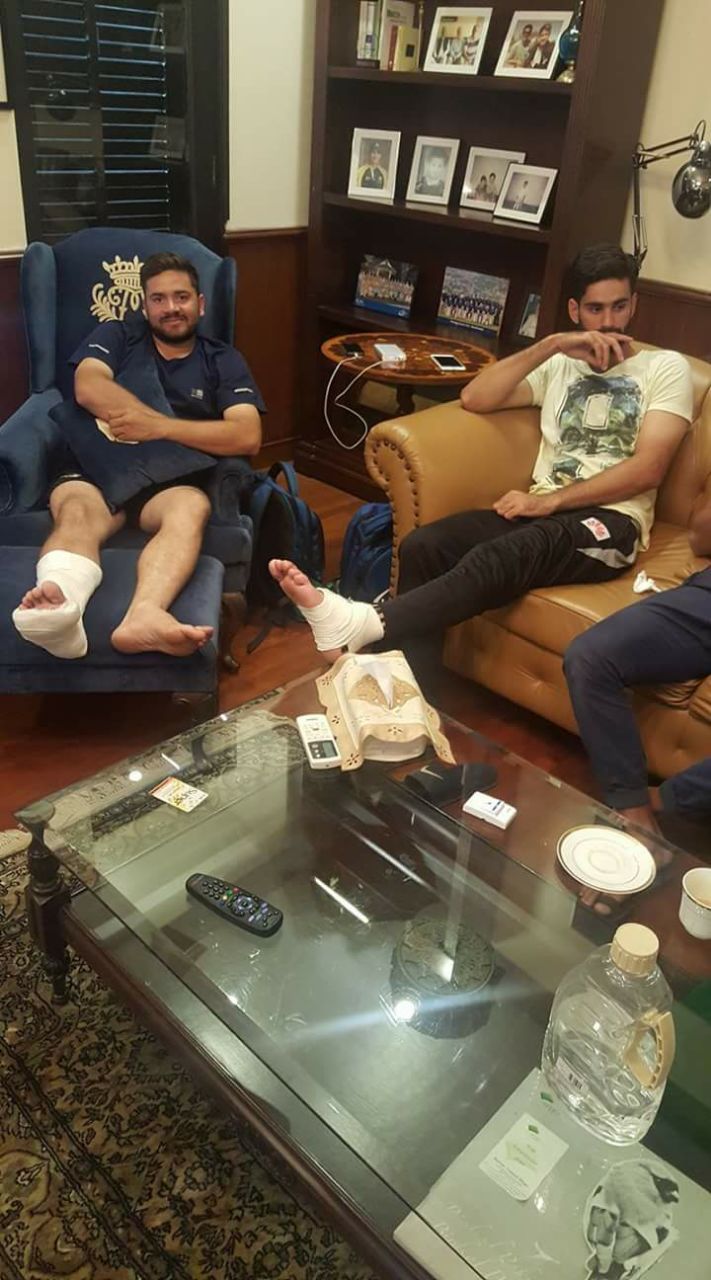
The deadly fire that erupted in a hotel in Karachi on December 5, 2016 that killed 11 people and injured over 70,  also hurt some Pakistani cricketers who were staying at the hotel. According to reports cricketers from UBL's first-class team that included some international Pakistan cricketers like Sohaib Maqsood, Hammad Azam and Umar Amin were in Karachi to play Quaid-e-Azam Trophy's super 8 round match vs HBL. When the fire set ablaze they with their team were staying in hotel and the tragedy resulting in injuries to UBL' cricketers Yasim Murtaza and Karamat Ali. Although shaken themselves, but other cricketers notably Sohaib Maqsood along with his teammates, helped in rescuing guests trapped inside the ablaze building, Besides, helping in evacuation a few families and small children they also helped in rescuing and evacuating Chinese officials affected by the fire.


This brave and humanitarian act of  cricketers to save life of others putting their own lives in danger, shows a positive characteristic of Pakistan' socio-civic culture, which is struggling to  survive from uproar and instability fueled by militancy and bad governance. That also indicates that attitude of national society is changing and it is heading towards positivity. Since the last two decades people living here were badly affected by horrors of terrorism which resulted in poor law and order and bad governance. Human lives were in a state of survival, therefore foriegners were afraid of touring Pakistan. However with these rescuing attempt of cricketers, it seems now people living in Pakistan including sportsmen have now understood that "God don't help those who don't help themselves."

It also reminds me a well known sporting family of Lyari, who lost their lives while resisting young and under-trainee pugilists of their boxing club to involve in criminal activities. The deceased are named Muhammad Ismail, his elder brother Javed and Taj Muhammad, maternal uncle Taj Muhammad, and their two cousins Shoaib and Faisal. All of them were national-level boxers and running a training academy in Singhu Lane. That boxing coaching centre was in operation for youngsters of Lyari for several years. But when gangsters tried to recruit members from their boxing club, the family not only resisted their attempt, but also started a campaign to stop young men from joining the gangs.

The gangsters working for notorious warring leader Uzair Baloch, therefore, started harassing the family and forced them to flee Lyari. The members of the family kept in wandering from one neighbourhood to another as gangsters had torched their houses in Singhu Lane. After few weeks of their relocation, a group of 12 gangsters tracked them down, kidnapped all of them and brutally killed them on March 9, 2014.

Two and half year later on November 19, 2016, the law Rangers in Karachi in a raid killed three hitmen including Mullah Arif who was supposed to be the main perperator of the gangsters group that killed the members of boxing family. The warlord of the gang Uzair Baloch has already caught earlier this year and is now in custody of law enforcement agencies.


However the residents of Lyari claim that the killing of Mullah Arif is an important success in the ongoing crackdown on Lyari’s criminal syndicates and will further weaken the notorious warring gang .


By M. Wasim

mwasim.370@gmail.com